Green Valley Co-op lifted yield 19% and cut water use 26% with IoT field monitoring and precision advisory
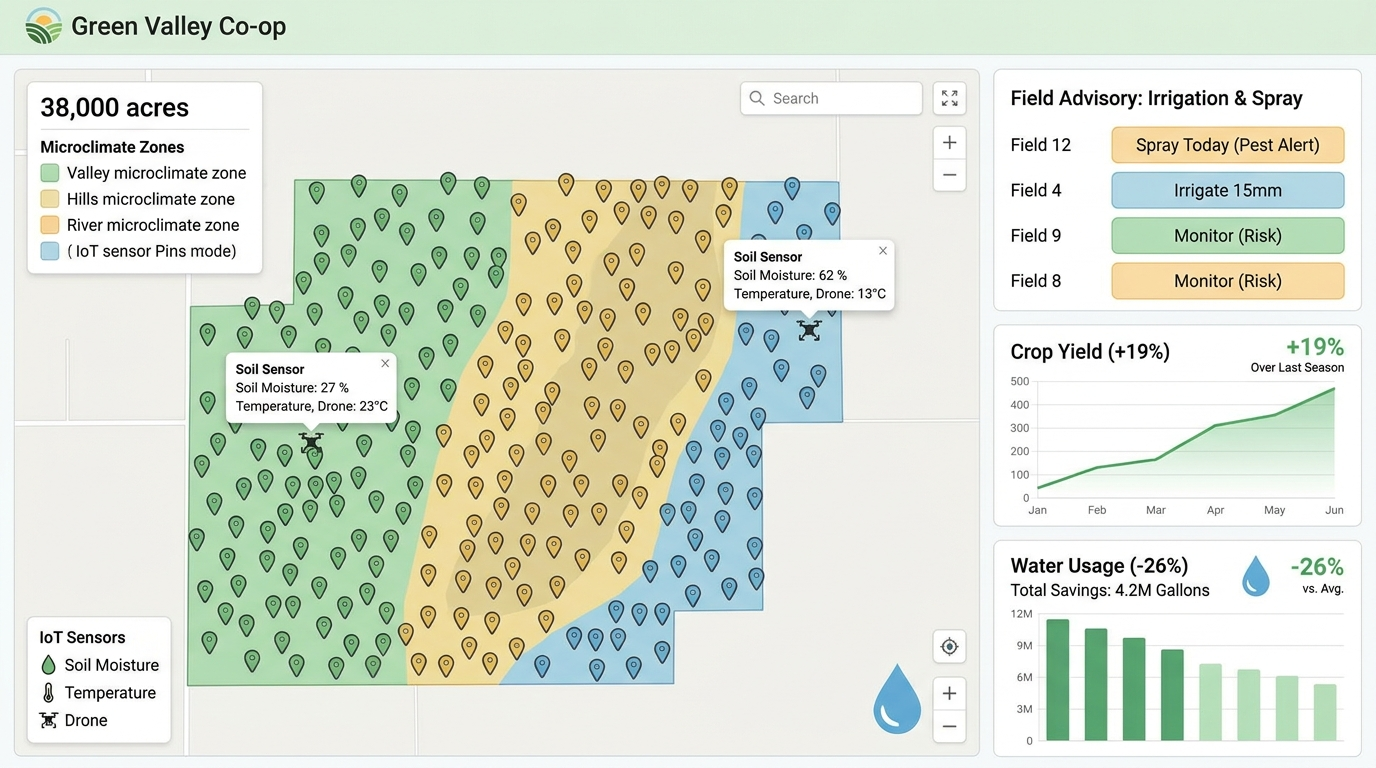
A 1,400-member grower cooperative was farming by the calendar instead of by the field — same fertilizer, same irrigation, same spray schedule on every acre. A farm management platform with IoT soil and weather sensors and per-field advisory turned guesswork into data, freeing $1.8M in input costs the first season.
Green Valley's 1,400 member farms covered 38,000 acres across three microclimates, but every grower was working off the same county-wide weather report and a fertilizer schedule printed in 2019. Over-watering was the norm — the cooperative's irrigation pumps ran $610K a year in electricity and water the agronomists knew was wasted, but nobody could prove which fields needed less. Pest outbreaks were spotted 5–7 days late on average, by which point a quarter of a crop could be lost. Buyers were also starting to demand farm-to-shelf provenance records the co-op couldn't produce without three weeks of manual paperwork per shipment.
We deployed our Farm OS platform with IoT soil-moisture, temperature and weather stations across a representative sample of fields per microclimate, a per-field advisory engine that turns sensor data and forecasts into daily irrigation, fertilization and spray recommendations, and a crop traceability timeline that records every input and harvest event against a verifiable field record. Growers get a mobile app with their fields' recommendations; the co-op gets a dashboard showing input spend, yield forecast and provenance packets ready for buyers. The platform went live in 10 weeks and replaced the printed schedule, the manual pest-scout log, and the three-week provenance paperwork.
We'd been farming the same way our grandfathers did and hoping the weather cooperated. The first season with per-field advisory, we cut water by a quarter and still came in 19% higher on yield. The provenance packets alone won us two new retail buyers — they wouldn't even take a meeting before we could prove the chain of custody.