
Meadowbrook Dairy lifted profit per cow 17% with a single ERP unifying herd, feed and milk operations
A 2,400-cow dairy was running herd health, feed rationing, and milk production on three disconnected systems and a clipboard. A custom ERP built around the dairy's actual workflow surfaced $1.9M in trapped margin — mostly in feed waste, missed vet visits, and milk that missed its quality bonus.
This is an illustrative case study. Company names, identifying details, and testimonials have been changed to protect client confidentiality. The technical solution and target outcomes are representative of the work we do. We extend the same confidentiality to every client.
Where they started
Meadowbrook's 2,400-cow operation tracked herd health in a vet's app, feed rationing in a nutritionist's spreadsheet, and milk production in the processor's portal — none of which talked to each other. Feed was 58% of operating cost and was being over-delivered by an estimated 7% because rations weren't adjusted for each pen's production. Vet visits were scheduled on a clipboard at the parlor, and 1 in 9 health events was caught a full cycle late, costing an average of $340 per cow in lost production and treatment. Most painfully, Meadowbrook was consistently missing the milk-quality bonus from its processor — worth $1.2M a year — because somatic cell count spikes weren't tied back to the specific pen and cow in time to intervene.
What we built
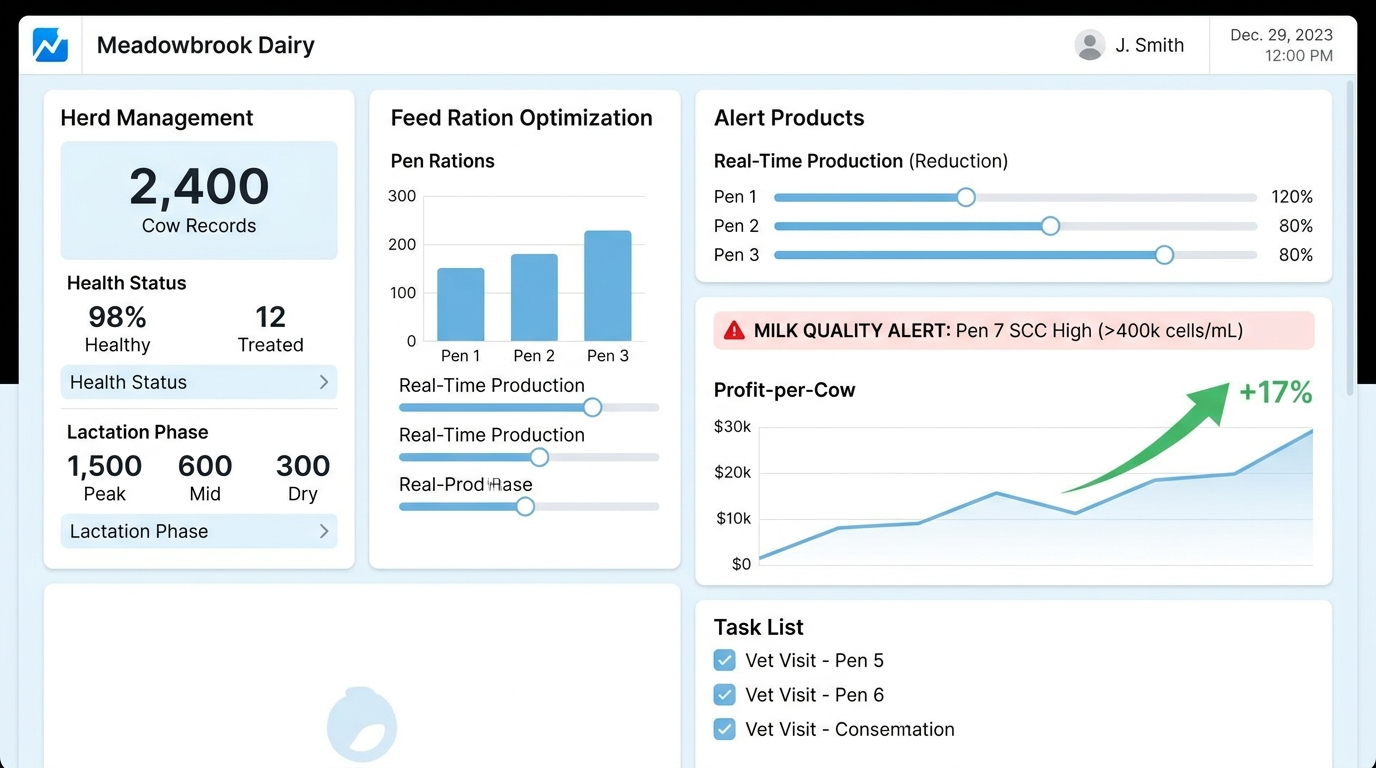
We deployed our ERP System tailored to dairy operations: a herd module tracking every cow's health, lactation and breeding record with automated vet visit scheduling; a feed module that adjusts ration delivery per pen based on real-time production data from the parlor; and a milk module that ties somatic cell count and quality metrics back to the specific pen and cow, alerting the herd manager the moment a pen drifts. A single dashboard shows profit per cow, feed cost per litre, and quality-bonus status in real time. The platform went live in 13 weeks and replaced the vet app, the nutritionist's spreadsheet, and the manual quality-bonus reconciliation.
Target outcomes
More from this project
We were running a 2,400-cow dairy on a clipboard and three apps that didn't talk to each other. The day the quality-bonus alerts went live, we caught a cell-count spike in pen 7 before it spread — that one alert was worth more than we used to make in a month of bonuses. The feed savings alone paid for the platform in the first quarter.
Representative testimonial — name and role changed to protect client identity.