/ Professional Services

Professional Services

Sell time, project it, invoice it.

Time tracking, project management, resource allocation, and client billing. Built for agencies, consultancies, and professional service firms who bill by the hour.

/ Live demos for Professional Services

See what we've built.

ERP System

A full-featured ERP system covering finance, procurement, inventory, sales, and HR & payroll in one unified dashboard. Built for mid-market companies that need to connect their financial and operational data without the complexity of legacy ERP suites.

Details
https://erp-system.theinternetcompany.tech
Open demo

Client Portal CRM

A CRM with a client-facing portal — contacts, deals, tickets, and shared documents in one place where both your team and your clients can work. Built for service businesses that want to look polished and stay organized.

Details
https://client-portal-crm.theinternetcompany.tech
Open demo

Project Hub

A project management workspace with Kanban boards, Gantt charts, task tracking, and team workload views. Built for teams that need visibility into who's working on what and when things will be done.

Details
https://project-hub.theinternetcompany.tech
Open demo

Doc Vault

A document management platform with version control, e-signature workflows, and full audit trails. Built for organizations that need secure, compliant document handling with a modern user experience.

Details
https://doc-vault.theinternetcompany.tech
Open demo

Integration Hub

An integration platform (iPaaS) with pre-built connectors, visual flow builder, field mapping, webhook tester, and sync logs. Built for teams that need to connect SaaS apps and automate data flows without writing custom code.

Details
https://integration-hub.theinternetcompany.tech
Open demo

Cortex

Cortex is an internal knowledge and intelligence platform that ingests documents, conversations, and data sources, then surfaces answers and insights through a single searchable interface. Designed for organizations that need a shared brain across teams.

Details
https://cortex.theinternetcompany.tech
Open demo
/ Challenges we solve

The problems we fix.

01Time tracking accuracy and billable utilization
02Project profitability and budget tracking
03Resource allocation and capacity planning
04Client invoicing and accounts receivable
/ What you get

Features built in.

Time tracking with automatic timesheet generation
Project profitability tracking with real-time burn rate
Resource allocation with capacity planning and forecasting
Automated invoicing with Stripe/QuickBooks integration
Client portal with project status and document sharing
Utilization analytics with team and individual dashboards
/ Target outcomes

What you could see.

+22%
Billable utilization
+17%
Project profitability
-71%
Invoice cycle time
-34%
DSO (days sales outstanding)
/ Illustrative case studies

How it could pay off.

01
Case study · Brightwave Digital
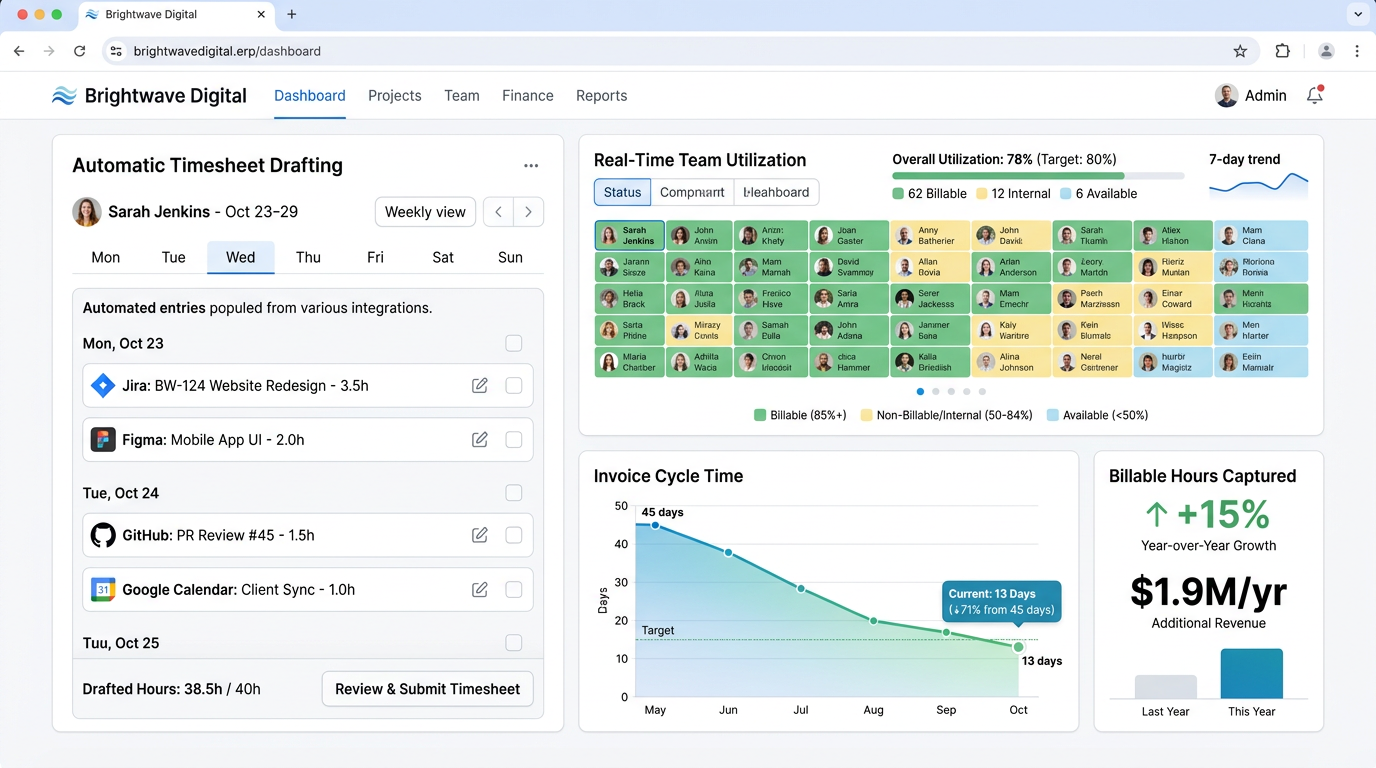
Brightwave Digital — Brightwave Digital recovered $1.9M in leaked billable hours and cut invoice cycle time 71% with automated time tracking and billing

Brightwave Digital recovered $1.9M in leaked billable hours and cut invoice cycle time 71% with automated time tracking and billing

An 80-person digital agency was losing 15% of billable hours to inaccurate timesheets and taking 45 days to invoice clients. A custom ERP with automatic time tracking, real-time utilization dashboards, and Stripe/QuickBooks invoicing recovered the revenue in the first quarter.

/ The challenge

Brightwave's 80 designers, developers, and strategists tracked time on a weekly spreadsheet that everyone filled out from memory on Friday afternoon — if they filled it out at all. The finance team estimated 15% of billable hours were never captured, which at an average $185/hr blended rate was $1.9M a year walking out the door. Invoicing was worse: project managers emailed spreadsheets to finance, finance reconciled them against SOWs by hand, and invoices went out an average of 45 days after the work was done. Days sales outstanding sat at 62 days, and the agency was carrying $2.4M in unbilled receivables at any given time. Three clients had disputed invoices because the hours didn't match their recollection of the work, and the agency had written off $140K in the last year alone to avoid the argument.

/ What we built

We deployed our ERP System tailored for agency operations, with automatic time tracking that captures time from the tools Brightwave's team already uses — Jira, Figma, GitHub, and Google Calendar — and drafts timesheets that team members approve instead of write. Real-time utilization dashboards show every team lead who's billable, who's on the bench, and who's over capacity, and project profitability tracking surfaces burn rate against SOW budget the moment a project starts to drift. Invoicing is now automated: approved timesheets flow straight into Stripe and QuickBooks with SOW-backed line items, and invoices go out the day a milestone closes. The platform went live in 7 weeks and replaced the spreadsheet, a separate time-tracking tool, and the manual reconciliation process.

+22%
Billable utilization
45 days → 13 days
Invoice cycle time
-34%
Days sales outstanding
+15%
Billable hours captured
$1.9M
Revenue recovered / yr
We knew we were leaking hours but we didn't know it was nearly two million dollars a year. The first month the automatic time tracking went live, we captured 1,200 billable hours we would have lost. And getting invoices out in two weeks instead of six changed our cash flow overnight — we stopped needing the credit line.
Megan Torres
COO, Brightwave Digital
02
Case study · Northbridge Consulting
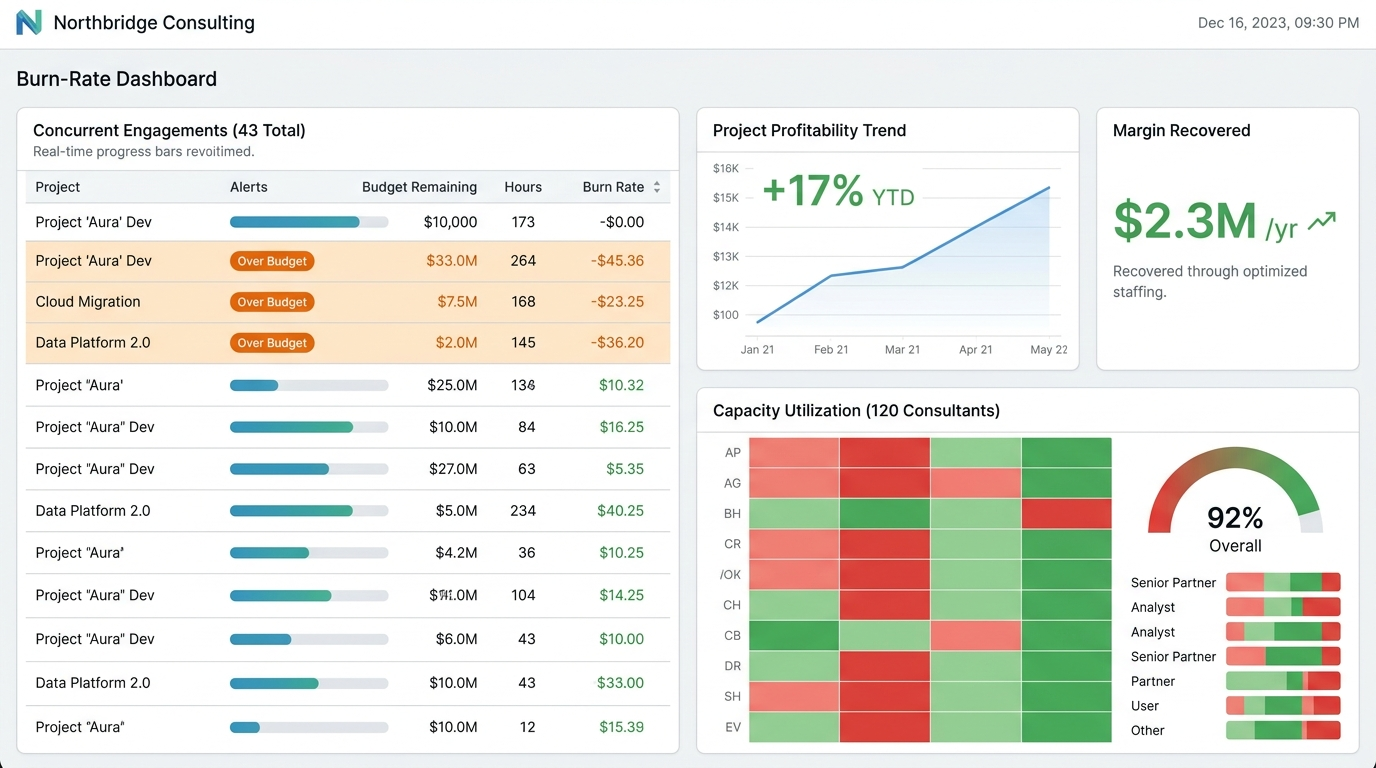
Northbridge Consulting — Northbridge Consulting found $2.3M in unprofitable projects and flipped margin +17% with real-time project profitability tracking

Northbridge Consulting found $2.3M in unprofitable projects and flipped margin +17% with real-time project profitability tracking

A 120-person management consultancy couldn't tell which engagements were making money until the quarter closed. A project management platform with real-time burn-rate dashboards revealed 28% of projects were losing money — and gave the partners the data to fix them before the damage compounded.

/ The challenge

Northbridge's 120 consultants ran 40+ concurrent engagements across strategy, operations, and implementation work. Project managers tracked budgets in a shared workbook updated weekly, and profitability was a number the finance team computed at quarter-end — by which point the over-budget projects had already bled margin for three months. The last quarterly review surfaced a sobering pattern: 28% of projects were delivering below cost, and nobody had known until the numbers closed. The senior partners estimated they'd lost $2.3M in the prior year to projects that ran over on hours but billed flat fees, and resource allocation was a guessing game — the firm was turning down new work while bench consultants sat idle because no one had a real-time view of capacity.

/ What we built

We deployed our Project Hub platform with Gantt and board views wired into real-time time tracking, so every logged hour updates the project burn-rate dashboard the moment it's entered. Project profitability is now visible from day one: budget vs. actuals, remaining runway, and projected margin update live, and the system flags any project that crosses 80% budget burn with less than 60% of deliverables complete. Resource allocation dashboards show capacity across the entire firm — who's on the bench, who's over-allocated, and who's skills-available for the next engagement — so partners staff projects from real data instead of memory. The platform went live in 8 weeks and replaced the shared workbook, a separate capacity-planning tool, and the quarterly profitability report.

+17%
Project profitability
-61%
Over-budget projects
-29%
Bench time
$2.3M
Margin recovered / yr
+22%
Capacity utilization
We ran an entire quarter not knowing a third of our projects were losing money. The first week the burn-rate dashboards went live, we caught two strategy engagements that were 40% over hours and still billing flat — we renegotiated both before the quarter closed. You can't fix what you can't see, and we'd been flying blind.
Jonathan Pierce
Managing Partner, Northbridge Consulting
03
Case study · Hartwell & Associates
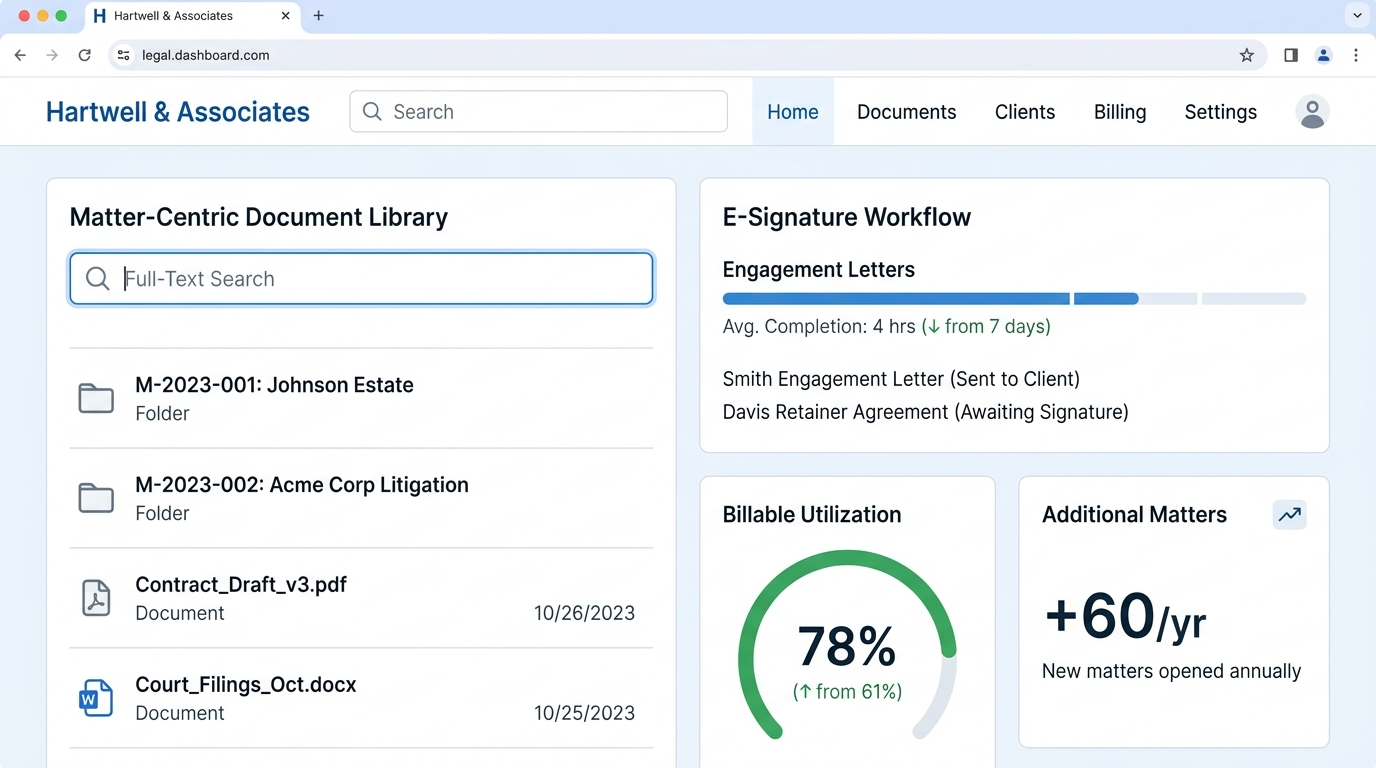
Hartwell & Associates — Hartwell & Associates cut document retrieval time 68% and added $1.4M in case capacity with a client portal and e-signature platform

Hartwell & Associates cut document retrieval time 68% and added $1.4M in case capacity with a client portal and e-signature platform

A 40-attorney law firm was losing billable hours to document chaos — every matter meant searching shared drives, emailing clients for signatures, and re-creating lost files. A secure document platform with client portal and e-signature collapsed admin time and unlocked capacity for 60 more billable matters a year.

/ The challenge

Hartwell's 40 attorneys across corporate, litigation, and IP practices managed matter documents on a network shared drive with no structure, no version control, and no search. Finding a single contract from a closed matter averaged 25 minutes, and paralegals spent an estimated 30% of their week hunting for files instead of drafting. Client collaboration meant emailing drafts back and forth — version collisions were constant, and the firm had once filed the wrong contract version in a $4M deal because no one could tell which was current. Engagement letters and retainer agreements went out on paper, sat on clients' desks for a week, and 1 in 6 came back unsigned. The firm was turning away work because attorneys didn't have the capacity, yet billable utilization was only 61% — the rest was eaten by document admin no one could bill for.

/ What we built

We deployed our Doc Vault platform with a structured matter-centric document library, full-text search across every file, and version control that makes the current version unambiguous. A branded client portal lets attorneys share document sets with clients securely, track who's reviewed what, and request e-signatures on engagement letters, retainer agreements, and closing documents — clients sign from their phone and the signed copy files itself to the right matter. Audit trails on every view, edit, and signature give Hartwell the compliance record its malpractice carrier required, and retention policies run automatically so closed matters archive on schedule. The platform went live in 6 weeks and replaced the shared drive, the paper signature process, and a legacy document tool no one used.

-68%
Document retrieval time
7 days → 4 hours
Engagement letter turnaround
61% → 78%
Billable utilization
+60
Additional matters / yr
$1.4M/yr
Added billable revenue
We were a 40-attorney firm spending a third of its paralegal hours looking for files. The first month after go-live, our retrieval time dropped from 25 minutes to 8, and engagement letters that used to sit on a client's desk for a week now come back signed the same afternoon. We took on 60 more matters this year without hiring — that's the real number.
Patricia Hartwell
Managing Partner, Hartwell & Associates
04
Case study · PixelForge Studio
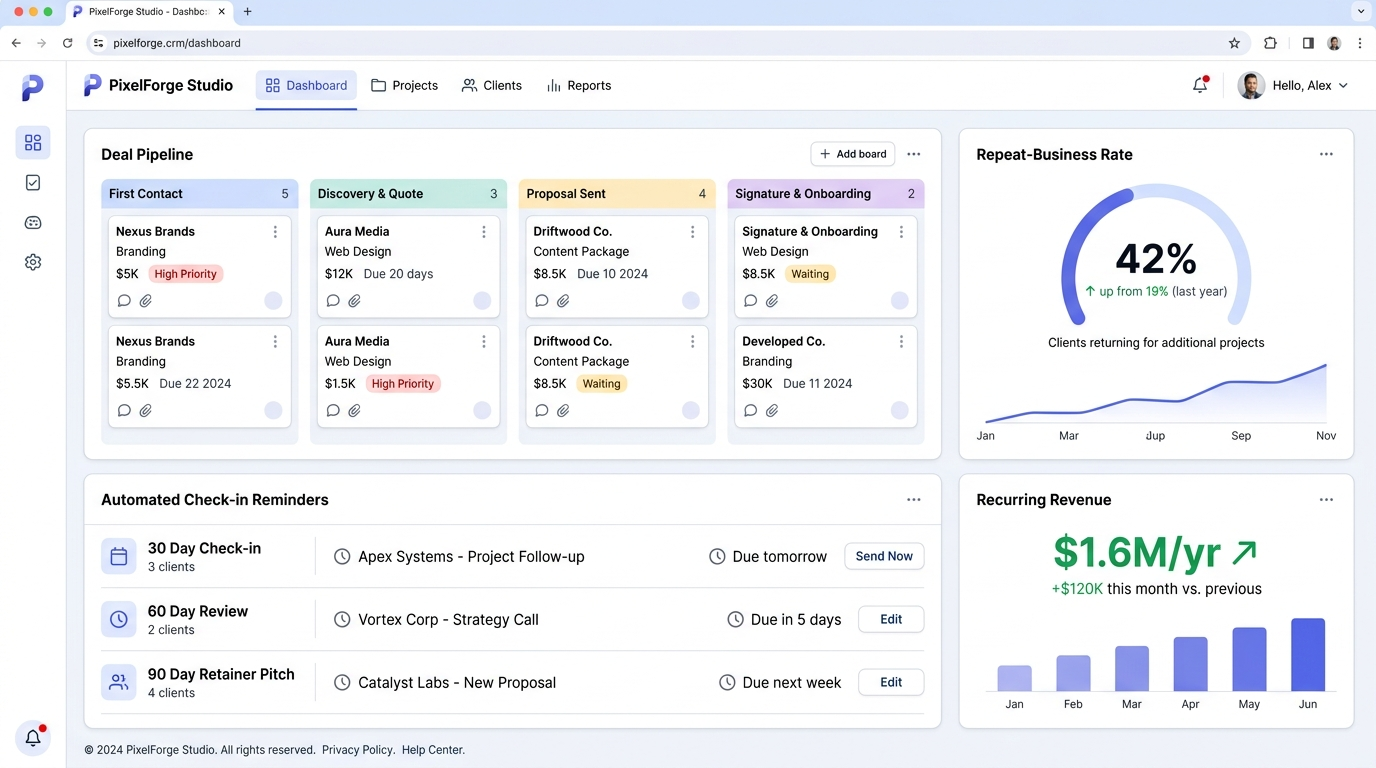
PixelForge Studio — PixelForge Studio grew repeat business 42% and added $1.6M in revenue with a client portal CRM and deal pipeline

PixelForge Studio grew repeat business 42% and added $1.6M in revenue with a client portal CRM and deal pipeline

A 25-person creative studio had no way to track client relationships or spot repeat business opportunities — past clients were forgotten the moment a project shipped. A client portal CRM with deal pipeline, project status sharing, and automated check-ins turned one-off projects into ongoing relationships worth $1.6M a year.

/ The challenge

PixelForge's 25 designers and developers delivered beautiful work, but the moment a project shipped, the client relationship went cold. There was no CRM, no pipeline, no record of past conversations beyond scattered emails. The studio's repeat business rate was 19% — well below the 45% industry benchmark for creative shops — because no one could remember which clients had been pitched what, when to follow up, or which past projects might lead to phase two. The founders tracked new business on a whiteboard and followed up on gut feel. Three clients who'd later admitted they 'would have come back' had instead gone to a competitor simply because the competitor called and PixelForge didn't. The studio was winning projects on portfolio quality but losing the recurring revenue that makes a creative business sustainable.

/ What we built

We deployed our Client Portal CRM tailored for creative studios, with a deal pipeline that tracks every prospect from first contact through proposal, signature, and project kickoff. Past clients are never lost — the CRM surfaces relationship history, past project value, and automated check-in reminders at 30, 60, and 90 days post-launch so the studio reaches out before the client even thinks to look elsewhere. A branded client portal lets PixelForge share project status, deliverables, and documents with clients in a polished environment that makes the studio look bigger than 25 people — and keeps the studio top-of-mind every time the client logs in. The platform went live in 5 weeks and replaced the whiteboard, a shared contact spreadsheet, and three separate tools the studio was paying for and not using.

19% → 42%
Repeat business rate
+58%
Deal pipeline value
+73%
Client follow-up rate
+19%
Proposal-to-close rate
$1.6M/yr
Added recurring revenue
We were a studio that could win any pitch but couldn't remember to call our own past clients. The CRM didn't just track deals — it reminded us to nurture the relationships we'd already earned. The first quarter, three clients we'd worked with two years ago came back for phase-two work because we finally reached out. That's $1.6M we would have left on the table.
Elena Vasquez
Co-Founder, PixelForge Studio
05
Case study · Apex Advisory Group
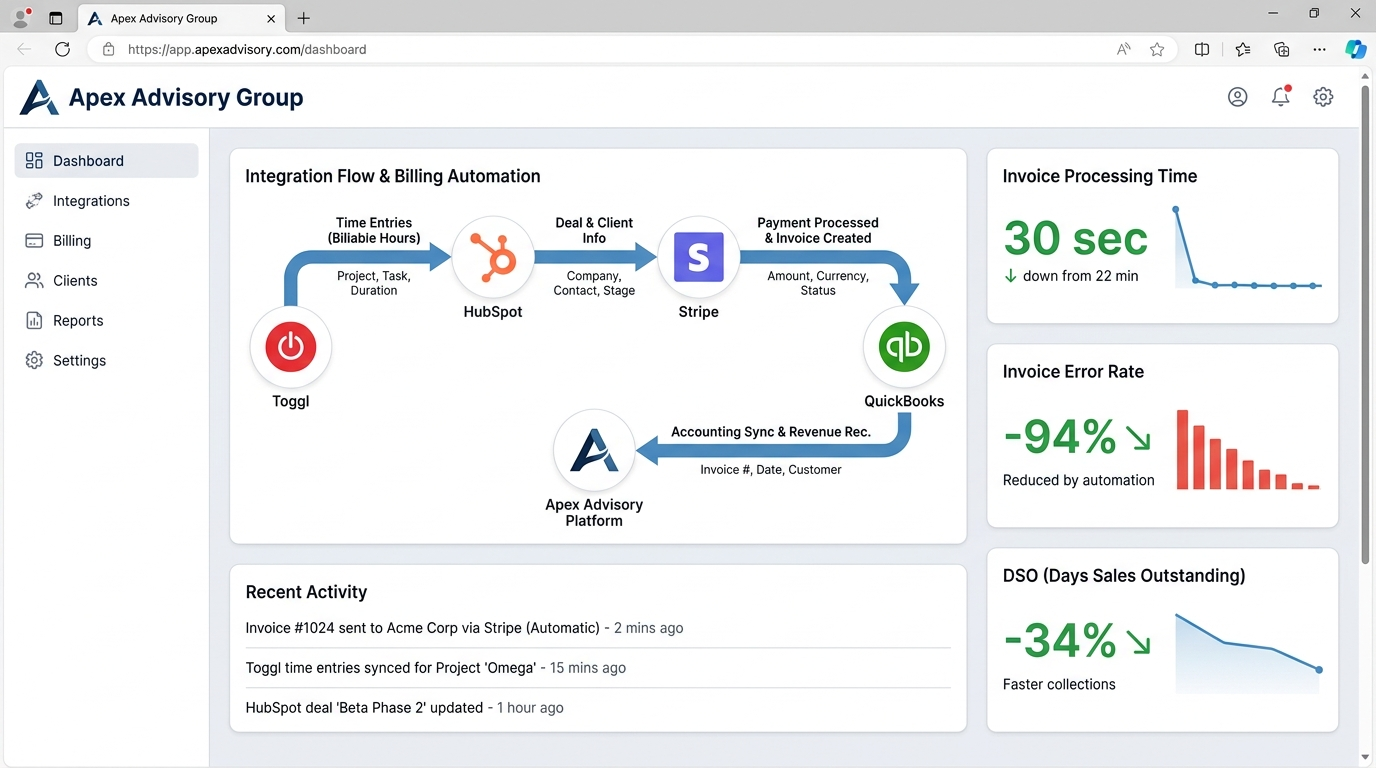
Apex Advisory Group — Apex Advisory Group eliminated $480K in manual billing admin and cut DSO 34% with custom API integration across QuickBooks, Stripe, and HubSpot

Apex Advisory Group eliminated $480K in manual billing admin and cut DSO 34% with custom API integration across QuickBooks, Stripe, and HubSpot

A 60-person advisory firm was manually reconciling billing data across four disconnected tools — every invoice meant copy-pasting between HubSpot, a time-tracking app, Stripe, and QuickBooks. A custom integration platform automated the entire billing flow end-to-end and freed three full-time finance hires worth of work.

/ The challenge

Apex's 60 advisors tracked time in Toggl, managed engagements in HubSpot, collected payments through Stripe, and kept the books in QuickBooks — and none of those tools talked to each other. Every invoice was a manual production: a finance clerk exported time from Toggl, cross-referenced it against the HubSpot deal record to confirm the SOW rate, created a Stripe payment link, and then re-entered the same data into QuickBooks once the payment landed. The process took 22 minutes per invoice, the four-person finance team spent 60% of its week on it, and data entry errors caused 1 in 12 invoices to go out wrong — triggering client disputes, rework, and delayed payments. Days sales outstanding sat at 58 days, and the CFO had hired two additional finance clerks in the last year just to keep up with billing volume that was growing faster than the manual process could scale.

/ What we built

We deployed our Integration Hub platform with custom connectors that link Toggl, HubSpot, Stripe, and QuickBooks into a single automated billing flow. Approved timesheets in Toggl now trigger the integration to look up the SOW rate in HubSpot, generate a Stripe payment link, send it to the client, and — once payment clears — create the matching invoice and revenue entry in QuickBooks automatically. Field mapping and transformation rules handle the rate logic and tax categories, and a sync monitoring dashboard shows the finance team every flow in real time with retry and error alerting so nothing silently fails. The platform went live in 6 weeks, and the entire billing flow that used to take 22 minutes per invoice now runs in under 30 seconds with zero manual data entry.

22 min → 30 sec
Invoice processing time
-94%
Invoice error rate
-34%
Days sales outstanding
$480K/yr
Finance admin cost saved
+3x
Billing volume capacity
We had four people in finance and three of them were essentially human copy-paste machines between four tools. The integration took the entire billing flow and made it automatic — invoices go out the day a milestone closes, the data is right because no one re-keyed it, and we redeployed two of those hires to actual financial analysis. The DSO drop alone improved our cash position by half a million.
Robert Chen
CFO, Apex Advisory Group
/ Solutions for Professional Services

Ready to try them?

01

Enterprise Resource Planning

One source of truth for every department.

View
02

Customer Relationship Management

Every lead, deal and conversation in one place.

View
04

Project & Task Management

Plan it, assign it, ship it, prove it.

View
05

Document Management (DMS)

Find any document in seconds, securely.

View
27

Custom APIs & Integration (iPaaS)

Make your tools talk to each other.

View