
LifeLine Health Network cut chart retrieval time 73% and saved $1.8M a year with a unified medical records platform
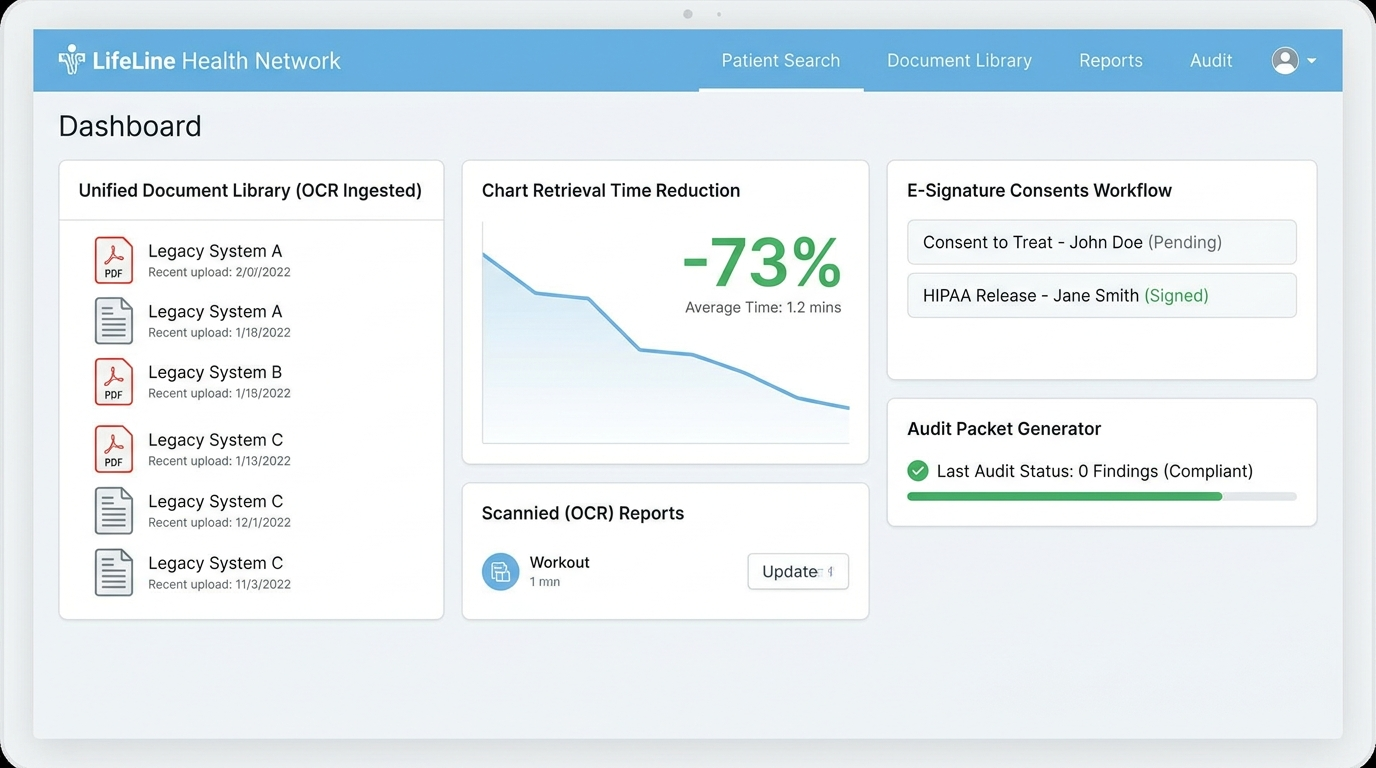
A 4-hospital network scattered records across paper, shared drives, and three legacy systems — every audit was a fire drill and every release-of-information request took days. A HIPAA-compliant document platform with e-signature and audit trails fixed it in 8 weeks.
This is an illustrative case study. Company names, identifying details, and testimonials have been changed to protect client confidentiality. The technical solution and target outcomes are representative of the work we do. We extend the same confidentiality to every client.
Where they started
LifeLine's 4 hospitals and 22 outpatient sites stored records across paper charts, three legacy EHR modules, and a network shared drive nobody trusted. Chart retrieval for a single patient averaged 3 days, release-of-information requests were backed up 6 weeks, and the compliance team spent 4 months a year preparing for audits. Paper and printing alone cost $1.9M a year, and consent forms went missing in 1 of every 7 admissions.
What we built
We deployed our Doc Vault platform with OCR-based ingestion that pulled records from all three legacy systems into one HIPAA-compliant library, e-signature workflows for consents and release-of-information, granular role-based access, and full audit trails on every view and edit. Retention policies now run automatically and audit packets generate in minutes.
Target outcomes
More from this project
Our last audit before this was four months of people sleeping at the office. The first audit after go-live, the packet generated in 20 minutes and we had zero findings. The paper savings alone paid for the platform.
Representative testimonial — name and role changed to protect client identity.